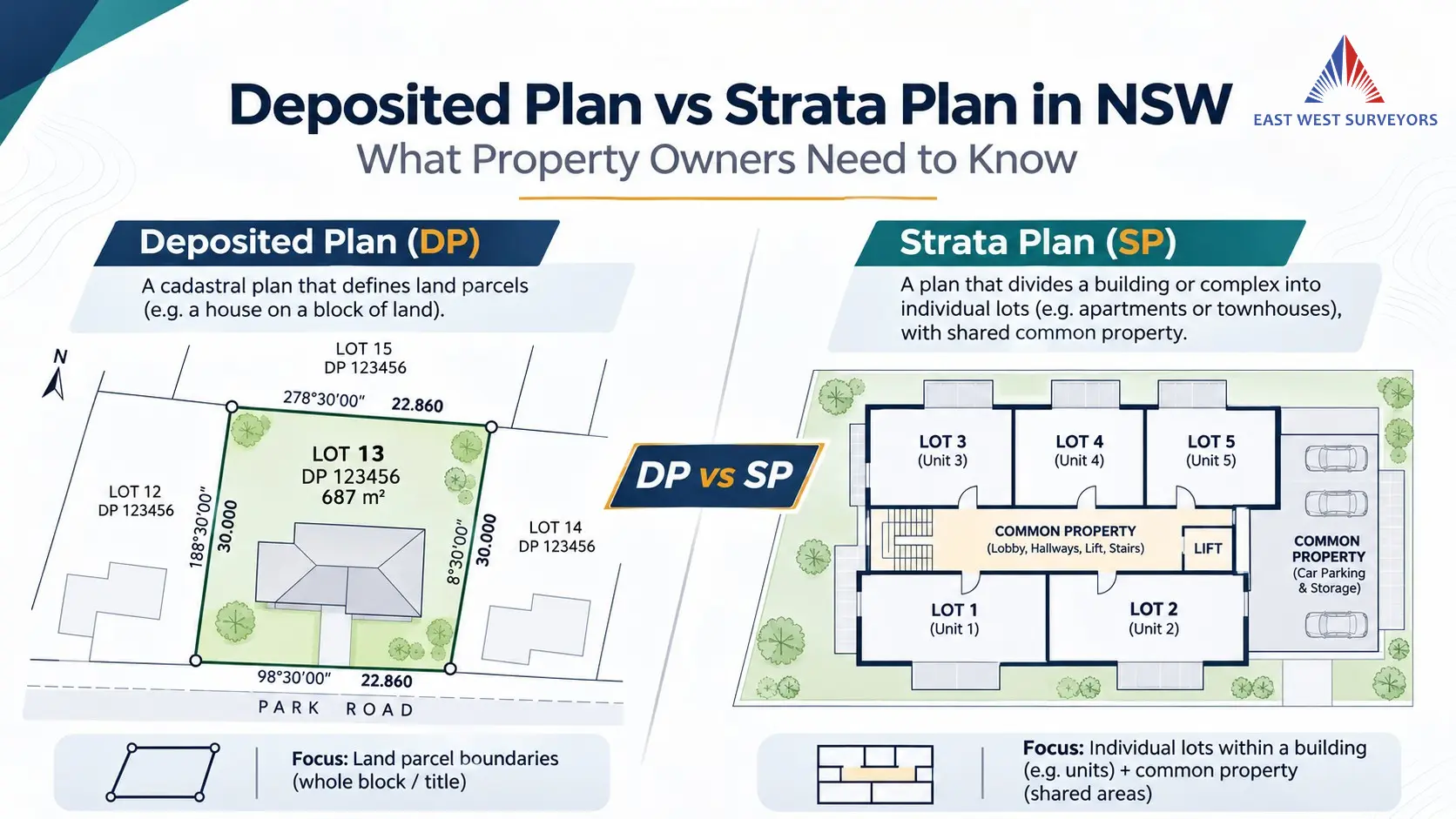
A deposited plan usually defines land parcels and their boundaries. A strata plan defines individual strata lots and common property within a scheme. Both are registered land records, but they show different parts of the ownership picture.
The quick answer: A deposited plan defines where the physical land boundaries lie, while a strata plan defines who owns individual spaces (and shared areas) within a specific building.
For NSW home buyers, owners and small developers, this difference matters. It can help you understand whether a courtyard belongs to your lot, how a car space is recorded, or which plan your surveyor needs.
Start with the letters beside the plan number: DP means deposited plan. SP means strata plan.
What Is a Deposited Plan in NSW?
A deposited plan is lodged with NSW Land Registry Services (NSW LRS). Most new deposited plans define or redefine land boundaries to support subdivision, land consolidation and other land dealings.
A typical deposited plan shows:
- Lot numbers and total land areas.
- Boundary lengths and directions (bearings).
- Roads and adjoining land.
- Easement sites and references.
- Survey marks and other physical boundary evidence.
For example, a property described as “Lot 2 in DP 123456” points to a specific parcel of land.
However, the drawing is only part of the story. Read it with the current title search and any documents referred to on the title. Where relevant, an 88B instrument sets out terms for easements, restrictions and other interests.
What Is a Strata Plan in NSW?
An original strata plan sets out the individual lots and common property in a strata scheme, typically found in apartment buildings, townhouses, villas, and duplexes.
The registered plan shows where your lot ends and the common property begins. That line may be less obvious than a standard garden fence.
NSW Registrar General’s Guidelines require strata plans to include administration sheets, a location plan and a floor plan. The floor plan defines the exact boundaries of the strata lots.
A strata lot can include more than one separate space. A unit, garage and storage area may form parts of the same lot. In another scheme, parking may be a separate lot or common property subject to use rights.
Never assume that a space belongs to you just because you alone use it. Check the plan and relevant by-laws.
Deposited Plan vs Strata Plan: What Are the Key Differences?
| Feature | Deposited plan | Strata plan |
|---|---|---|
| Plan reference | DP followed by a number | SP followed by a number |
| Main focus | Land parcels and boundaries | Strata lots and common property |
| Typical detail | Bearings, distances, areas and easement sites | Lot layouts, boundary notes and building relationships |
| Common use | Subdivision, consolidation or boundary redefinition | Separate ownership within a strata scheme |
| Key owner question | “Which parcel is this, and what defines it?” | “What forms my lot, and what is common property?” |
Note: A strata scheme sits on land with its own parcel history, so a property search may lead to both DP and SP records.
How Can the Difference Affect Your Property?
Buying a home
Picture two townhouses with a shared driveway. They look identical from the street, but appearance won’t tell you how the land is held.
Always check the title and registered plan.
The NSW Government advises buyers to check the strata plan and by-laws because common property can differ between schemes.
Planning a renovation
If you want to move a wall or alter a courtyard, first establish whether the work affects your lot or common property.
In strata, owning the unit does not mean every wall, slab or roof forms part of your lot. Renovation approval requirements depend on the work and the scheme’s rules.
Planning a subdivision
You don’t choose a deposited plan or strata plan based on which seems simpler. The proposed layout, planning approval and intended ownership structure guide the required plan.
East West Surveyors can help assess the surveying scope for Torrens title subdivision or strata subdivision.
What Should You Check Before Relying on a Plan?
Use this checklist before buying, designing or building:
- Match the reference: Check the lot and plan numbers against the current title.
- Get every sheet: Important notes may sit beyond the main drawing.
- Check registration: A draft plan is not the registered record.
- Read boundary notes: Pay close attention to height limits and separate lot spaces on strata plans.
- Follow document references: Review relevant easements, restrictions and by-laws.
- Confirm the survey scope: A title plan does not replace current site measurements.
Scaling a distance from a PDF cannot reliably establish a legal boundary on the ground.
If you need a boundary physically located on-site, ask about a boundary identification survey.
Frequently Asked Questions
How do I find my deposited plan or strata plan?
Start with your title details or contract documents. NSW LRS search tools can help identify plan references. Copies of strata plans are available through approved information brokers.
Does a strata plan show who must repair something?
It helps establish where lot boundaries end and common property begins. However, repair duties also depend on strata legislation, by-laws, and other scheme records. You must review these documents together.
Can I use a deposited plan to set out a new building?
Not on its own. A registered surveyor must legally relate the boundaries to the physical site and use the relevant approved building plans to ensure accurate set-out.
Get Clear About Your Property Before You Build
Unsure what your DP or SP means for your project? Contact East West Surveyors with your property address, plan reference and proposed work. Get the exact survey scope and a clear quote before your project moves ahead.